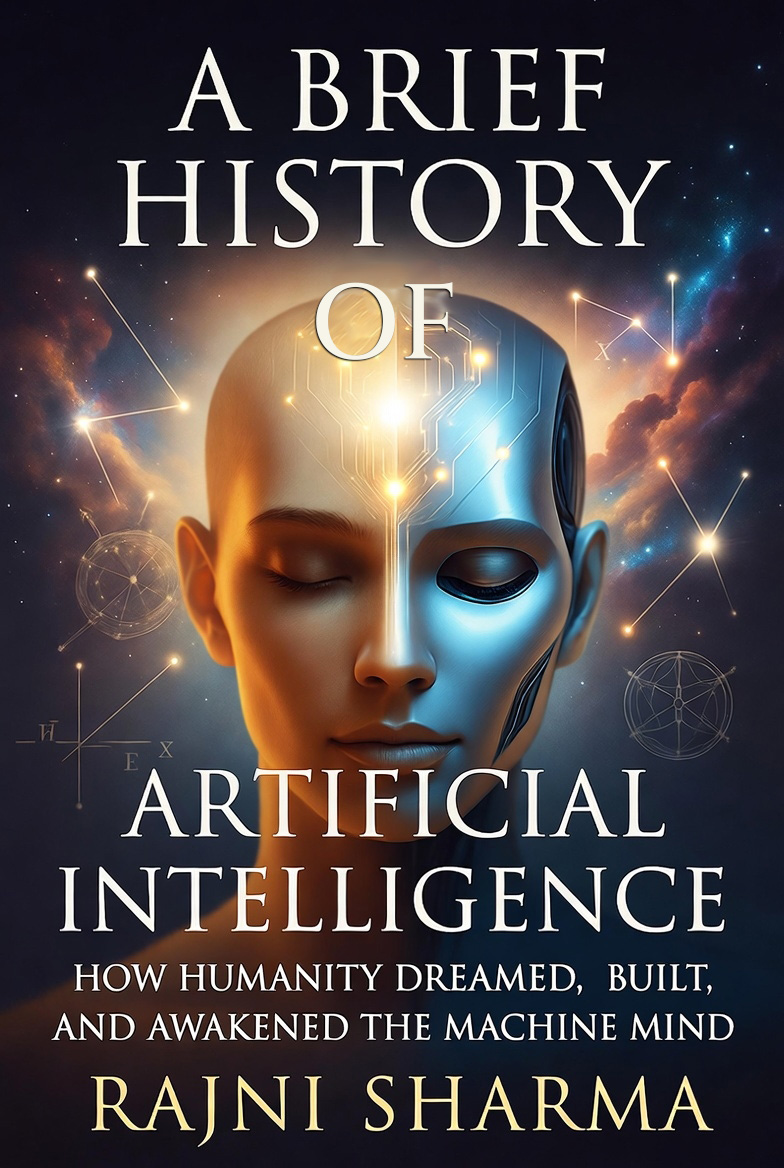
A Brief history of Artificial intelligence: How Humanity Dreamed, Built, and Awakened the Machine Mind
This book is is a narrative exploration of humanity’s timeless desire to create thinking beings — a journey that spans ancient myths, philosophical inquiry, mathematical logic, and modern machine learning. Rather than focusing on technical instructions, this book asks deeper questions: Why did humans dream of intelligent machines long before they could build them? And what does that dream reveal about us?
What This Book Explores
- This book offers a sweeping, human-centered history of artificial intelligence, covering:
- Early myths and legends of artificial life, from ancient automata to sacred stories
- The philosophical foundations of intelligence and reasoning
- The birth of logic, computation, and symbolic thinking
- Key thinkers who shaped AI’s foundations, including Aristotle, Ada Lovelace, Alan Turing, and John McCarthy
- The transition from rule-based machines to learning systems
- The rise of neural networks, deep learning, and generative AI
- Ethical, philosophical, and existential questions surrounding machine intelligence
- Each chapter connects technological progress to the human ideas that made it possible.
Not a Technical Manual — A Human History
- Unlike most books on artificial intelligence, this work does not explain how algorithms function line by line. Instead, it explores why humans felt compelled to create intelligence in the first place.
- By blending history, philosophy, and science communication, the book reveals AI as a cultural and intellectual achievement — shaped as much by myth and imagination as by mathematics and engineering.
- Readers come away with a broader understanding of AI as a continuation of humanity’s oldest questions about mind, consciousness, and creation.
Key Themes Explored
Throughout the book, readers encounter enduring questions that define the AI conversation: > What does it mean to think? > Can intelligence exist without consciousness? > Are machines merely simulating understanding — or something more? > How do our values and biases shape the intelligence we create? > What responsibilities come with building thinking systems? These themes make the book as much a philosophical reflection as a historical account.
Who This Book Is Perfect For
This book is ideal for: > Curious readers interested in the history of artificial intelligence > Students exploring AI, philosophy, or science history > Technologists seeking a broader, humanistic perspective > Educators and discussion groups Readers fascinated by the intersection of technology, ethics, and consciousness > Anyone wondering what AI reveals about human intelligence itself No technical background is required.